
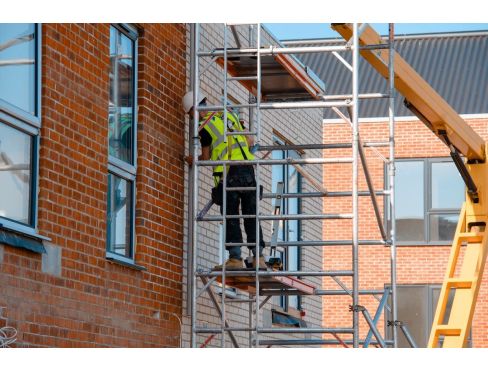
To help alleviate some mystery, the team at TopTower has answered some of the most commonly asked questions we are posed about scaffolding.
Can you use scaffolding on stairs?
Scaffolding can be erected on staircases, but standard scaffolding or a conventional tower should not be placed on stairs or levelled using improvised materials. Specialist equipment designed for stairways should be used instead.
Stairs, stairwells and split level areas present a particular challenge because a conventional tower relies on a stable and appropriately level base. Trying to compensate for different heights with timber, bricks, blocks or other makeshift supports can introduce a serious fall risk.
Fortunately, specialist access equipment is available for these situations. Stairway scaffolding towers and stairwell access equipment is designed specifically for challenging access areas.
For example, a specialist stairwell solution can provide:
A stable working platform across a staircase or uneven area
Adjustable legs to accommodate changes in level
Guardrails and suitable edge protection
A more compact footprint for confined spaces
A safer alternative to improvising with a standard tower
How much does scaffolding cost?
The cost of scaffolding varies considerably depending on a number of factors, including:
For traditional scaffolding, a quotation will normally take into account factors such as:
The size and height of the building
How much of the building needs to be accessed
The type of scaffold required
Ground and site conditions
How easy the site is to access
How long the scaffold will remain in place
Whether additional equipment or protection is required
Whether the scaffold needs to occupy a public pavement or highway
Labour and erection costs
Any required licences or permissions
Do you need a licence to erect scaffolding?
In the UK, you may need a local authority licence if scaffolding is going to occupy a public area. If the scaffolding remains entirely on private property, a highway licence will generally not be required, although other permissions or requirements may apply.
If scaffolding is being erected around a house but remains entirely within the property's boundary, the highway licensing requirements may not apply. However, if standards, supports or other parts of the structure extend onto the pavement or road, permission may be required before work begins.
The exact process is managed locally, so requirements can vary between councils. Councils may have their own application processes, fees, insurance requirements, conditions and lead times.
If you're a homeowner arranging scaffolding, ask the contractor whether a highway licence is required and who will be responsible for obtaining it.
Can you put scaffolding up yourself?
You may be capable of erecting a scaffolding tower without professional assistance, but this depends on the type and height of the tower in question.
A suitable scaffold tower can be assembled by people who have the appropriate knowledge, training and competence for that equipment, while conventional scaffolding should be erected by trained and competent scaffolding professionals.
A scaffolding tower is a modular access system designed to be assembled according to the manufacturer's instructions. Full scaffolding is different. It involves a much more complex structural arrangement, including standards, ledgers, transoms, ties, bracing and foundations. This type of scaffolding should be put up by a trained and competent builder or scaffolding contractor.
If you're considering assembling a scaffolding tower yourself, you should:
Choose equipment appropriate for the task and working height
Read and follow the manufacturer's instructions
Ensure the ground and surrounding area are suitable
Use the specified components and configuration
Never improvise with missing or incompatible parts
Make sure anyone assembling or using the tower has the necessary competence
Follow the required inspection and maintenance procedures
PASMA training is a recognised route for people who regularly use mobile access towers. PASMA provides courses covering the safe assembly and use of scaffold towers, with training options depending on the type of tower being used.
Do you need training to use scaffolding?
UK legislation does not specifically state that every person using a mobile scaffold tower must hold a PASMA certificate. However, people carrying out work at height must be competent to do so, and employers have responsibilities around training, supervision, planning and suitable equipment.
A person using or assembling a scaffold tower should understand the equipment, its limitations, and the risks involved. They should know how to assemble it correctly, inspect it before use, work within its safe loading and height limits and recognise when conditions make it unsafe.
PASMA training is widely recognised within the access industry and is commonly required by employers, principal contractors and commercial sites. It can provide clear evidence that a worker has received recognised training, even though the certificate itself is not universally mandated by law.
How long does it take to put scaffolding up?
The time required can range from a couple of hours for a small access tower to several days for a large or complicated scaffold.
The size of the structure is obviously important, but it is only part of the picture. A straightforward two storey house may be relatively quick to scaffold, whereas a building with restricted access or complicated elevations can take multiple days.
You should expect:
|
Project |
Approximate erection time |
|
Small access tower |
Up to 2 hours |
|
Single storey property |
2–4 hours |
|
Standard two storey house |
3–6 hours |
|
Larger domestic property |
Around 1 day |
|
Multistorey commercial building |
1–3 days |
|
Complex industrial scaffolding |
2+ days |
How is scaffolding erected?
Scaffolding is built progressively from a stable base upwards, with each stage contributing to the stability and safety of the completed structure. You should always follow the manufacturer’s instructions.
For traditional scaffolding, the process will vary according to the system and the design, but typically the process will be as follows:
Site assessment: Before anything is assembled, the scaffold needs to be planned around the building, access requirements, ground conditions, overhead hazards and surrounding environment.
Base preparation: The supporting surface needs to be suitable and stable. Base plates and, where appropriate, sole boards are positioned to distribute the load.
Building the framework: Standards provide the vertical structure, while ledgers and transoms create the horizontal framework. Bracing is incorporated to provide additional stability.
Adding working platforms: Scaffold boards or the appropriate platform system are installed as the structure progresses.
Installing edge protection and access: Guardrails, toe boards and suitable access arrangements help protect people working on and around the scaffold.
Securing the structure: Depending on the design, ties and other measures may be required to connect the scaffold to the building and maintain stability.
Inspecting the finished scaffold: The completed structure needs to be checked before use, with ongoing inspections carried out as required.
What are the weight limits for scaffolding?
The safe load depends on the type and design of the scaffold, its configuration, the platform and components being used, and the manufacturer's stated capacity. The intended use also matters because people, tools and materials all contribute to the load.
This is why you should never assume that a large scaffold automatically has a higher safe working load than a smaller one.
The manufacturer's instructions and specification should always be checked before materials are placed onto a platform. This is particularly important for scaffold towers, where exceeding the stated capacity can affect stability and safe use.
If you’re searching for height access equipment that puts safety at the heart of every design feature, TopTower has a wide range of ladders and steps that are suited to professional use. We also offer a range of scaffold towers, plus plenty of handy ladder accessories, making it easy to find the right access equipment for you and your business.
Meta description: Get answers to the most common scaffolding questions, including costs, permits, training, erection times, weight limits, maintenance and more.


